Central Saint Martins Live 2015


Till ‘the wedding’ starts…
... in the summer in 2015. I was in Vienna, Austria. The main reason I visited Vienna was that I wanted to see works by Egon Schiele and Gustav Klimt. It was much hotter than I expected. I needed to calm down with a cigarette and to start exploring from areas that I wasn’t really interested in, in order to enjoy Egon Schiele or Gustav Klimt area without sweating like a pig.
One day, I walked into a space that was filled with paintings of food. I couldn’t stop looking at them. Maybe it was just because I love food. Somehow, the richness of fruits or seafood caught my attention and didn’t let me go.
Well, we will come back to this later…

JEAN-SIMÉON CHARDIN
Still Life with a White Mug | 1764
Egon Schiele
Stylized Flowers in Front of a Decorative Background | 1908

Walking into the Laboratory…
‘Central Saint Martins Live’ is the final outcome of a collaboration project called ‘Practice Exchange’.
This project started in October in 2015. There were 8 other artists(Korallia Stergides, Beckie Cove, Lore Molina, Arielle Francis, Charlie Chung, Raphael M. V. Schulenburg, George Turner, Joseph Craig) in this project. We started working together to present a 30 minutes show in December 2015.
We started giving random words to each other and created mini performances in small group/individually.
I spent the first 10 years of my life in China, because of my parents job. My teenage was in Japan. I moved to London to study art/design, when I was 20 years old.
I decided to focus on my experience among different cultures.
The fear of new cultures
When I meet a new culture, I always have a feeling that I am being rejected. The situation makes me feel really difficult to find who I am or where I belong to.


Screen shots from the video documentation of a mini performance | 2015

Charlie, Raphael and I created a scratch performance. This performance is about a girl tries to approach to a new culture. She gets rejected from the new culture. When she tries to go back to where she thinks she belongs to (the culture she used to belong to), she gets rejected from there as well. By exploring cultures more and more, she finds and builds herself in-between those two cultures.
Through this performance, I found that we failed to show that the girl gets influence from cultures visually. I also found that Charlie is not a performer in a good way. She will do anything that she agreed with, but she is always herself. She doesn’t try not to laugh/smile. She doesn’t act. I think that she has a very strong skill.
Facing the Fear… and failure
I realised that I can’t and probably shouldn’t be afraid of new cultures, when I was 11. The scratch performance made with charlie and Raphael remind me how I approached to new cultures. Basically, I attempted to fit in. It was a hard time for me back then, but I could experience a lot in order to find what I actually like and what I really hate.
Attempt 1: appearance
I tried to dress how others dressed. I tried to get what others had.
Attempt 2 : copying
I tried to do what others did. (playing video games, etc)
Attempt 3 : taking in
I tried to get knowledge about new cultures without experience them.
At this stage, most artists wanted to work individually, so we decided to create our own short performances. I decided to visualise my 3 attempt.


Minshin Yano
Movement plans for the '3 attempts' performance | 2015
Through the ‘3 attempts’ performance, I really wanted to dig deeper into the fear I had. At the same time, as a group, we tried to find a shared theme for the show. However, we were interested in different subjects. This was how I understood what other artists were interested in.
Korallia and Beckie : communication through body and objects
George : writing scripts, acting
Arielle : women power
Charlie : n/a
Joseph ; sexuality ?
Raphael : physical in-between space, failure
Lore : n/a
So we decided to do the game called ‘word-dissociation’. We got 3 random words to work on !!!
“Calamari” “More” “Scone”
Calamari, more, scone…
The word dissociation game was really interesting. One person needs to shout the first word came in his/her mind that relates to the word another one said.
For example, sugar -> sweet -> honey -> bear …
When we talked about calamari…
“Calamari…what is it?” “It’s an Italian dish,isn’t it?” “Fried squid rings!!”
When we talked about scone…
“So British!!” “I love scone” “I hate scone” “I’ve never had scone before I come to London”
Through researching, I found that ‘calamari’ is a recipe/menu word for squid and scone has a long history behind it. It doesn’t really matter.
I really liked how people connected those two foods to their experience and how they stereotype food.
We are related on stereotype a lot, when we are communicating. Our stereotypes are created and shaped through our experience. We have different stereotypes of same thing.
For example, if I say “calamari”, one might think of deep fried squid rings, another one might think of boiled squid with tomato sauce.
The mechanism of stereotype is quite interesting.
Try this…
Whenever you had an apple, it was red. Apples in photos/TV/paintings were always red.
For you, apples were always red. You've never seen an apple in any other colour in your life.You actually no longer even consciously care about the colour of apples.
One day, your closed fried offers an apple. The apple is in green.
Would you eat it without asking your friend what the hell it is/why the hell the fruit is apple?
Would you? I wouldn’t.
Some stereotypes of cultures annoyed me a lot. When the information becomes stereotype is when the information is lack of knowledge, research, etc. However, everybody is afraid of unknown things. The green apple might have toxic. Stereotypes might make us feel fear, but they might also help us to avoid danger.
To analyse my thought at this stage,my stereotype of ‘stereotype’ was how someone understand something. Nobody defines the meaning of every single word in a conversation. Nobody has the true definition of every single words. In everyday life, we talk as if everybody has the same definition of every single word. Somehow, the conversation is constructed, even with loads of misunderstanding is going on.
So… I wondered”Why don’t we open up our stereotype and share it?”
Mind map was the best way of exploring how I understand words(calamari/scone)

Minshin Yano
Mind map for Scone | 2015

Minshin Yano
Mind map for Calamari | 2015

Minshin Yano
Initial Score for Calamari, More, Scone | 2015
Wedding yet?
We still had interests in different areas. It was difficult for some artists to show all of them without solid structure. Some artists didn’t know how to present themselves in a chaotic environment. Some artists left the project because they strongly wanted to work invidiously. We chose wedding as a situation to gather all or our pieces and to create a show collectively.
How to show CHAOS?

I filmed Lore and edited the video.
Here is the process of how I make the video look like delayed Skype Video phone screen.
We structured chaos by using ‘A Midsummer Night's Dream’ by William Shakespeare as a reference.
Lore could not be in the show, so we decided to use Lore as the bride, and the bride not coming to the wedding as a trigger for a chaos(individual performances).
To create a wedding, we decided to choose characters needed in a wedding. I decided to be a chef in the wedding, as “Calamari, More, Scone” is almost a food preparation.
Bride in a monitor…
In order to show the bride is not in the wedding space, we decided to use Lore in a monitor as if she was trying to get married with a guy on Skype.
That’s how we started created the wedding in terms of story telling.
I decided to be a chef in the wedding, as “Calamari, More, Scone” is almost a food preparation.


Minshin Yano, Arielle Francis, Charlie Chung, Raphael M. V. Schulenburg, George Turner
Lighting Design (rough drawings)
2015
Minshin Yano
Porster for Practice Exchange First Performance 2015

Minshin Yano, Arielle Francis, Charlie Chung, Raphael M. V. Schulenburg, George Turner
The Wedding (27mins) | 2015
As a reflection, I think we didn’t really research about wedding, because lack of time and lack of performers. We didn’t research about characters we chose at all. We almost forced ourselves to be characters and forced characters to do extra actions to finish the story. However, I found that we could create the story very easily, if we have committed to our characters and have set up the characters. At one point, I could see what my character will do the next.
After the performance, I have got same comments from few people…
Actually, YES!! Wanking is the best word to describe ‘the wedding’. We just wanted to show our own performance. I would describe ‘the wedding’ as a collage of performances rather than one show.
It was all about Wanking, wasn't it?
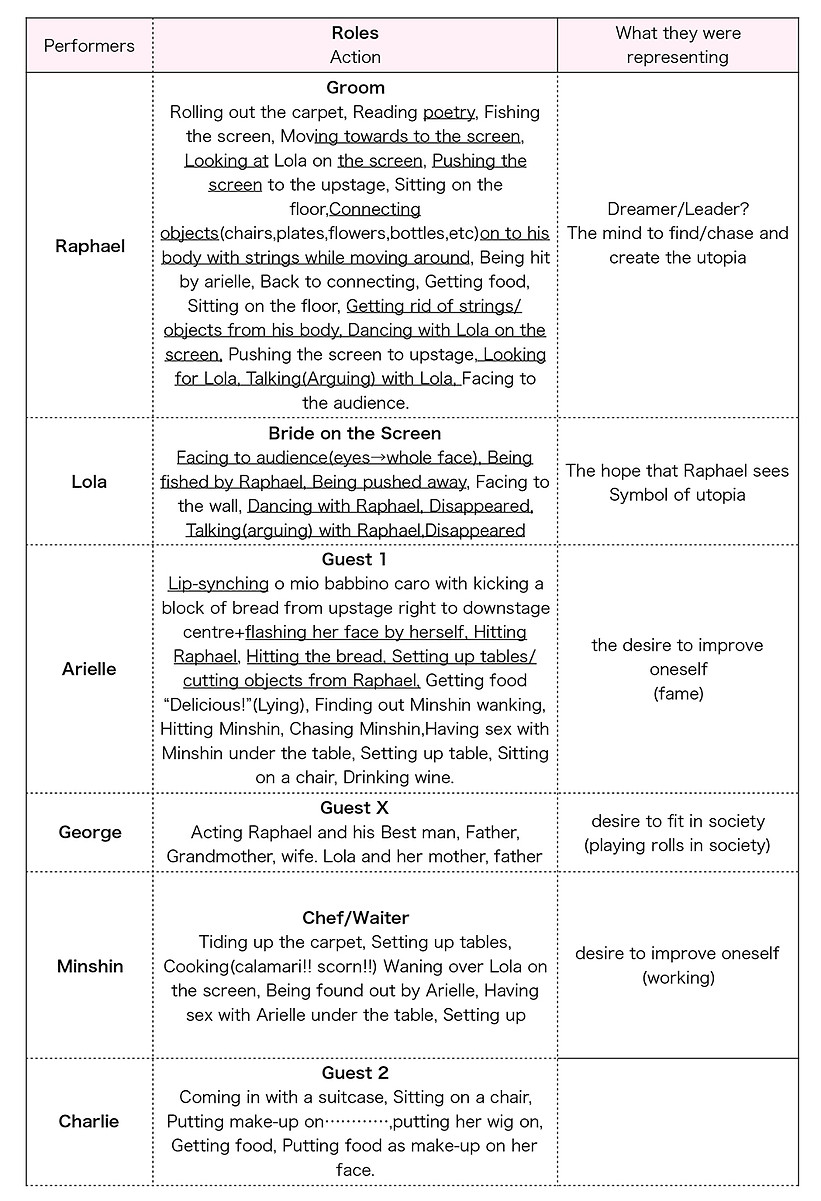
Minshin Yano
Character analysation|2015
I watched the documentation of ‘the wedding’ after performance. I tried to analyse the whole performance to rethink about the performance as a show instead of a collage of performances.
Even it was a difficult situation to collaborate, I found that Raphael and I had an overlapped interest.
Raphael created a performance about his relationship between himself and his past life. He ties up himself with strings onto object, and struggles with moving forward. He wanted to show how difficult it is to escape from past life. In my understanding, He was showing how difficult it is to escape from ‘Stereotypes’ that is constructed by experience in past life. By cutting his strings, I was helping him to deal with his ‘stereotype’(past life).
Although we forced ourselves to be characters, our characters made us easier to create hidden relationship between characters.


top
next page